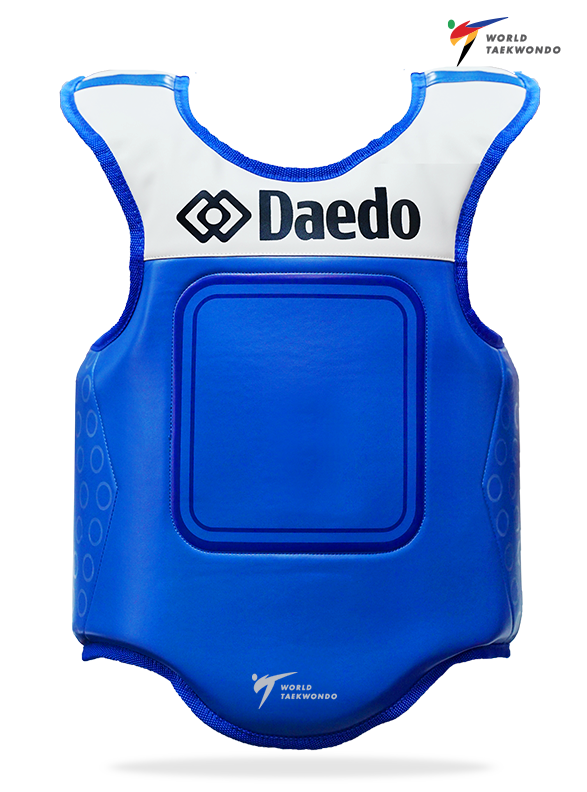
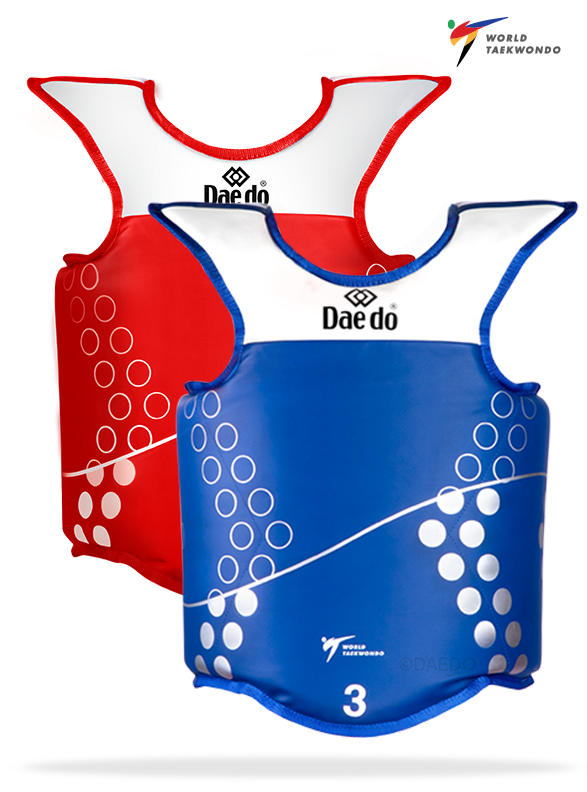
The objective is to equip Lebanon with six official electronic Taekwondo scoring sets for real match play — each supporting two athletes on one match area. The comparison below focuses on Daedo GEN2 and GEN3 Protector Scoring Systems (PSS).
0
match sets
0
athletes per set
0
judge boxes / area
2026
recognition expiry
Daedo GEN3 PSS — Officially Certified by World TaekwondoReference · Daedo / WT
PRIMER · PSS in plain language
How electronic Taekwondo scoring actually works.
If you have never seen an electronic match: this is the 3-minute mental model behind the entire budget conversation. No jargon, no acronyms left unexplained.
The 5-step signal chain
1
The athlete kicks or punchesForce hits a sensor on the opponent’s vest (hogu), headgear or foot sock.
2
The sensor measures the impactIt checks zone, force and — with GEN3 — the angle/quality of the hit.
3
A small transmitter sends it wirelesslyThe hogu and helmet each carry a battery-powered “walkie-talkie” that radios the data to the table.
4
The receiver / software decidesOne central laptop runs the scoring software, decides if the hit is valid and adds the points.
5
Judges & screens make it officialFour judge boxes confirm technical points; a TV / LED screen shows the score to the public.
One-line analogy
A PSS is basically a boxing scoreboard with smart clothing. The vest and helmet act like contactless payment terminals — every legal kick is a “tap” that registers automatically, and the laptop is the cash register that totals the bout.
GEN2 is the proven older version of that system — reliable, well-known by referees, but using older radio & software. GEN3 is the same idea, redesigned: better sensors, fewer false hits, cleaner signal, more storage for tournament data, and — critically — the version Daedo and World Taekwondo are pushing toward future international eligibility.
Buying GEN2 today is like buying a phone that still works perfectly but is two generations old: cheaper, fine for training and local events, but you must check that international tournaments will still accept it after the 2026 recognition expiry.
Side-by-side, in human language
GEN2
“The trusted, lower-cost option — still recognised, but with an expiry clock.”
Lower up-front cost per set
Familiar to referees / coaches already trained
WT recognition expires 31 Dec 2026 — must reconfirm renewal
Older radio & software, more manual calibration
Best for: training centres, local championships, transition phase
GEN3
“The forward-compatible standard — higher cost, longer useful life.”
Newer sensors — fewer disputed hits
Improved wireless reliability & tournament data export
Path of choice for international qualification events
Higher initial investment, but better long-term ROI
Best for: federation-level events, international hosting, Olympic prep
Hogu
Korean name for the electronic chest vest worn by each athlete.
PSS
Protector & Scoring System — the full electronic refereeing kit.
Transmitter
Small wireless device that sends sensor data to the central laptop.
Receiver
USB unit + software that interprets hits and runs the match clock.
Judge box
Handheld controller used by 4 judges for technical / spinning kick points.
Match set
Everything needed for one match area: 2 athletes × full gear + table equipment.
03 · One ready match set
What's inside one PSS match set?
One match area · two athletes · all the electronics required to run a sanctioned bout.
×2
Body protectors / hogus
Electronic chest sensors per athlete.
×2
Electronic headgear
Sensor-equipped helmets.
×2
Foot protectors / sensor socks
Sensor pairs for foot strikes.
×2
Head transmitters
Wireless signal from helmet to receiver.
×2
Body transmitters
Wireless signal from hogu to receiver.
×1
Receiver + software
Match scoring brain.
×4
Judge boxes / joysticks
Manual scoring + technical points.
×1
Transmitter charger
Charging dock for transmitters.
Excluded from base price: laptop/PC, scoreboards, TV/LED display, mats, cables, power backup, network, installation, shipment, customs, VAT, spare sensors and spare sizes.
04 · WT recognition
Recognition is the control reference.
WT lists Daedo GEN2 and GEN3 v2 as recognised PSS — but with an expiry date of 31 December 2026. Written confirmation for 2027+ must be obtained before any purchase order.
--days
--hours
--minutes
--seconds
until current WT recognition expiry — 31 Dec 2026
GEN2 PSS
WT recognised PSS list shows expiry date: 31 December 2026. Older generation — avoid large new purchase unless discount is strong or use is mainly local/training.
GEN3 v2 PSS
WT recognised + Daedo announcement of broader international eligibility. Recommended option — but require written 2027+ recognition confirmation before final purchase.
Internal review
Decision review by September 2026. Do not wait until December 2026 to check recognition renewal.
05 · GEN2 budget · 6 sets
GEN2 — the entry-budget benchmark.
Reference: TKDScore / Daedo TrueScore USA public pricing. USD. Revalidate before any PO.
Component
Qty
Unit
Subtotal
Gen2 E-HeadGear
2
$399
$798
Gen2 E-Chest Gear Adult
2
$775
$1,550
Gen2 Head Transmitter
2
$390
$780
Gen2 Chest Transmitter
2
$390
$780
Gen2 E-Foot Gear
2
$95
$190
Gen2 Receiver
1
$390
$390
Gen2 W.T. Software
1
$99
$99
Gen2 Judge Box (refurbished)
4
$580
$2,320
Gen2/3 transmitter charger
1
$55
$55
Per set
$6,962
× 6 sets
$41,772
06 · GEN3 budget · 6 sets
GEN3 — the strategic platform.
Price range across public distributors. USD, converted from EUR at 1 EUR = 1.08 USD. Lower = Pride Shop + Daedo official; upper = Budopunkt comparable config.
Lower reference
$61,464 / 6 sets · ≈ €56,916 EUR source
Component
Qty
Unit
Subtotal
GEN3 electronic headguard
2
$443
$886
GEN3 electronic body protector
2
$778
$1,556
GEN3 e-headguard transmitter
2
$637
$1,274
GEN3 e-body protector transmitter
2
$637
$1,274
GEN3 sensor sock
2
$81
$162
GEN3 PSS receiver
1
$1,193
$1,193
GEN3 PSS software
1
$107
$107
GEN3 PSS judge joystick
4
$948
$3,792
Per set
$10,244
Upper reference
$65,880 / 6 sets · ≈ €61,020 EUR source
Component
Qty
Unit
Subtotal
GEN3 E-headguard
2
$431
$862
GEN3 e-trunk protector
2
$800
$1,600
GEN3 E-head transmitter
2
$720
$1,440
GEN3 E-trunk transmitter
2
$720
$1,440
GEN3 sensor sock
2
$81
$162
GEN3 wired receiver box
1
$1,067
$1,067
GEN3 software
1
$121
$121
GEN3 judge scoring box
4
$1,072
$4,288
Per set
$10,980
Range view
Lower vs Upper reference
Position GEN3 as a national technology upgrade — fairer scoring, better competition credibility, alignment with the latest Daedo PSS generation.
07 · Cost difference & recommendation
Scoreboard · GEN2 vs GEN3
GEN2GEN3↔
Drag to compare GEN2 (left) and GEN3 (right).
GEN2 · USD
$0
for 6 sets · entry budget
VS
GEN3 · USD
$0
for 6 sets · strategic platform
Scenario:
Recognition risk
GEN2:Higher — older, expires 31 Dec 2026.
GEN3:Lower tech risk, written 2027+ confirmation still required.
Strategic value
GEN2:Useful for training / local events if discounted.
GEN3:Better for national / international readiness and image.
Youth training days · operator training · maintenance
Positioned as youth-development support
Access-to-sport visibility
Sustainability model: a dedicated PSS equipment fund — every official event contributes a service fee covering software updates, spare transmitters, sensor socks, repairs, batteries, operator training and upgrade planning.
Sponsor coverage calculator
How many partners at each tier? See how close you get to fully funding all 6 sets.
Sets funded: 0 / 6
Raised (est.): €0
10 · Lifecycle & timeline
From decision to operation.
Now → Jun 2026
Request official quotations
Confirm 2027+ WT recognition status in writing. Do not purchase from public web prices alone.
Nine curated references — official Daedo GEN2 and GEN3 videos, a live tournament demo, install & set-up guide, an athlete review and a GEN3 technology article. Useful for federation reviewers, coaches and operators.
GEN3
GEN3 · Certification
GEN3 PSS — Officially Certified by World Taekwondo
Official Daedo announcement of the GEN3 system and its WT certification.
GEN2
GEN2 · Operation
GEN2 — Instructional Guide
Daedo’s official instructional walkthrough for the GEN2 PSS.
GEN2
GEN2 · Operation
GEN2 — Additional Features
Advanced configuration and lesser-known features of the GEN2 system.
GEN2
Support · Maintenance
GEN2 — Troubleshooting & Maintenance
Field-level diagnostics, common failures, and maintenance routines.
TrueScore
Setup · Software
TrueScore — Setup & Troubleshooting
End-to-end PSS setup and troubleshooting using Daedo TrueScore.
GEN3
GEN3 · Live demo
GEN3 in action — 2023 US Open demo
Live tournament footage of the GEN3 system being used at a major international event.
Install
Setup · Installation
Daedo PSS — Installation & Set-up Guide (KTA)
Daedo International’s official mat-side installation and set-up walkthrough.
GEN2
GEN2 · Athlete review
GEN2 foot & hand protectors — athlete review
An athlete unboxes and reviews the GEN2 foot and hand sensor protectors in training use.
Technical / coach (full)All slides + every embedded video + the Daedo GEN3 article on the Resources slide.
Keyboard shortcuts
← / → navigate slides · P presenter mode · F fullscreen · Esc close any popup.
Export
Use the PDF button in the top bar to produce a print-ready landscape file with all videos replaced by placeholder cards.
Funding path · 01
Federation & Ministry of Sports capital budget
The most legitimate route. Position the request as federal-level sports infrastructure, not consumables — the same way a federation requests vehicles or mats.
Pre-meet the Sports DirectorWalk them through PSS 101 — never present a budget cold; the technical primer pre-sells the number.
Submit before fiscal Q4Capital lines close earlier than operating lines. Aim for Q2 submission for next-year disbursement.
Co-sign with the National Olympic CommitteeAdds Olympic-discipline weight, unlocks parallel co-financing.
Request advance partial payment50% on PO, 50% on delivery — protects supplier confidence even if total release is staggered.
Pitfall — filing as a single line "electronic equipment". Always itemise per match set; treasurers reject opaque single-line capital requests.
Public
Capital
Highest legitimacy
Funding path · 02
Olympic Solidarity — equipment grant
Olympic Solidarity runs structured grants for National Olympic Committees, including Equipment for Athletes and Continental Development programmes. Taekwondo is a core Olympic sport — eligibility is real.
Target share
15–25%
Lead time
9–12 months
Cycle
Annual call
Action plan
Go through the NOC, not directlyOlympic Solidarity disburses via the National Olympic Committee — federation submits the file with NOC endorsement.
Frame as "Olympic-pathway readiness"Show how the equipment serves athletes targeting continental qualifiers and Olympic ranking events.
Attach a 4-year quadrennial planOlympic Solidarity funds plans, not invoices. Map equipment use to a multi-year athlete-prep cycle.
Bundle operator trainingGrants often cover training of officials/operators alongside equipment — request both.
Pitfall — missing the annual call window. Calls typically open in autumn; missing one cycle = 12-month delay.
International
Olympic
Annual cycle
Funding path · 03
World Taekwondo development & THF programmes
World Taekwondo and the Taekwondo Humanitarian Foundation fund inclusion, youth, refugee and women-in-sport initiatives. Equipment is rarely the headline — it is bundled as enabler infrastructure.
Target share
5–15%
Lead time
6–12 months
Form
Programme + equipment
Action plan
Anchor to a flagship programmee.g. "Lebanese girls' Taekwondo league across 4 governorates" — equipment serves the league, league justifies equipment.
Show MoU with at least 2 local NGOsWT favours partnerships, not solo federation asks.
Include measurement planAthletes trained, events hosted, women / youth ratio. WT requires quantitative reporting.
Co-brand eventsUse the WT logo on every event the equipment touches — strengthens next year's renewal.
Pitfall — asking only for hardware. WT funds programmes; equipment is a line inside a programme.
International
Programme-based
Inclusion
Funding path · 04
Private-sector CSR & title sponsorship
Banks, telcos, insurers and FMCG brands in Lebanon all carry a CSR / youth-development line. PSS is an unusually photogenic asset — modern, screens, light effects, athletes on camera — making it easy for marketing teams to justify.
Target share
20–35%
Lead time
3–6 months
Best targets
3–5 brands
Action plan
Build a one-page sponsor sheetBranding zones (ring, hogu sleeve, screens), reach numbers, photo mock-ups. Decision-makers do not read decks.
Shortlist 5 brands aligned with youth / sport / techTelco for the "tech" angle, bank for "investment in youth", insurer for "protection & safety".
Approach the marketing director, not the CEOCSR budget lives in marketing, not in the executive office.
Sign a 3-year MoU, not a one-offMulti-year deals stabilise sponsor planning and protect against year-1 enthusiasm drop-off.
Deliver a quarterly impact report3 photos, 1 metric, 1 story. Sponsors renew because of reporting discipline, not event quality.
Pitfall — chasing one big sponsor. Three medium sponsors at €15k is more resilient than one big sponsor at €45k.
Private
CSR
Brand-driven
Funding path · 05
Club contribution pool
Affiliated clubs benefit directly from the equipment — they should co-own it. A small per-club annual contribution turns the PSS into a federation-wide shared asset with broad political support.
Target share
5–10%
Lead time
1 season
Per-club ask
€300–800 / year
Action plan
Convene a clubs' assemblyCo-design the fee with them — clubs accept fees they helped set, reject fees imposed top-down.
Tier the fee by club size3 tiers based on athlete count. Avoid flat fees that hurt small clubs.
Tie payment to event-access priorityContributing clubs get first slots on PSS-equipped event days — fee becomes a service, not a tax.
Publish the ledger annuallyEvery euro shown against repairs, sensors, upgrades. Transparency = renewal.
Pitfall — treating it as a tax. Frame it as a co-investment with measurable benefits.
Community
Recurring
Democratic
Funding path · 06
Rental & certified-operator service model
The equipment generates revenue. Other federations (judo, karate, MMA exhibitions), schools, military games and corporate events all need scoring infrastructure occasionally. A small certified-operator team rents the kit + runs it.
Target share
10–20% recurring
Lead time
Post-acquisition
Day rate
€400–900 / set / day
Action plan
Certify a 4-person operator teamDaedo training + internal SOP. No equipment ever leaves without a certified operator.
Publish a service catalogueHalf-day rate, full-day rate, multi-day rate, with what's included (operator, setup, support).
Sign a frame agreement with the Ministry of EducationSchool/university championships are predictable recurring revenue.
Reinvest 100% into a maintenance reserveSponsors notice when revenue funds upgrades, not salaries.
Pitfall — renting without insurance. Equipment goes off-site = insurance and damage-deposit policy required from day one.
Recurring
Self-sustaining
Operational
Funding path · 07
Diaspora & alumni transparent campaign
The Lebanese diaspora funds visible, transparent, time-bound projects. A "buy a sensor sock, equip the next champion" campaign with a public donor dashboard converts emotional engagement into a hardware list.
Target share
10–20%
Lead time
2–4 months
Avg ticket
€50–€500
Action plan
Itemise the wish listHeadgear €399, sensor sock €150, transmitter €1,180, full set €10,500. Donors love specific items.
Build a public donor dashboardLive counter, items still needed, sponsor wall. Transparency multiplies trust.
Recruit 5 athlete ambassadorsEach posts a short personal video. Diaspora donates to faces, not federations.
Engrave donor names on equipment casesPermanent, low-cost recognition that re-energises donors at every event.
Run a 90-day sprint, then closeOpen-ended campaigns fail; deadlines convert.
Pitfall — sending donations into a generic federation account. Use a dedicated, audited PSS fund with a separate IBAN.
Diaspora
Crowdfunding
Time-bound
Sponsorship tier · Gold
Gold partner — naming rights on 2 rings
The flagship tier. Reserved for one or at most two partners per event cycle.
Equivalent funding
~ €21–22k
Sets enabled
2 full GEN3 sets
Term
3 years
Concrete deliverables
Co-naming on two competition ringse.g. "Ring 1 powered by [Brand]" on LED & printed signage.
Hogu sleeve patchAthlete-worn branding during every match using the funded set.
Opening / closing ceremony mentionScripted MC mention + step-and-repeat backdrop.
Quarterly impact reportReach, athletes trained, photos, social media metrics.
VIP delegation invitations2 reserved seats per official event for sponsor leadership.
Pitfall — over-selling Gold to multiple brands. Exclusivity is the value.
Sponsorship tier · Silver
Silver partner — one ring + visibility
The workhorse tier — typically 2–3 silver partners per cycle.
Equivalent funding
~ €10–11k
Sets enabled
1 full GEN3 set
Term
1–3 years
Concrete deliverables
Co-branding on one ringApron + corner signage.
Programme & livestream mentionLogo in lower-third graphics and printed programme.
Digital recognitionFederation site + monthly social-media mentions.
Annual impact certificateSigned by federation president, framed.
Sponsorship tier · Bronze
Bronze partner — components & consumables
Lower entry point — covers transmitters, sensor socks, screens, batteries, maintenance reserve. Great fit for smaller brands and local businesses.
Equivalent funding
€1–5k
What it funds
Consumables · spares
Term
1 year, renewable
Concrete deliverables
Logo on official materialsBanners, results sheets, federation site sponsor wall.
Mention in event communicationsPre/post event posts and press releases.
Tax-receipted contributionIssued via federation accounting for fiscal deductibility.
Sponsorship tier · Community
Community partner — youth & operator training
Non-financial / in-kind sponsorship: a partner funds training days, not hardware. Powerful for foundations, schools, ministries.
Form
In-kind / programme
Funds
Training · access
Visibility
Story-driven
Concrete deliverables
Sponsor 6 youth-training days per yearFree access to PSS-equipped sessions for under-resourced clubs.
Fund operator-certification courseBuilds the talent pipeline that keeps the kit running.
Featured story per quarterLong-form social/PR content highlighting an athlete who benefited.
Sponsor-pitch blueprint
How to build a winning sponsor pitch in 7 days.
Sponsorship deals are won on preparation, not budget size. Run this 7-day sprint before any meeting.
Day 1 — Define the pitch objectOne sentence: "We are equipping Lebanon with 6 internationally-recognised electronic Taekwondo arenas by end of 2027." Memorise it.
Day 2 — Build the one-pagerFront: visual mock-up of branded ring. Back: budget, sponsor zones, reach numbers, contact.
Day 3 — Shortlist 8 targets3 banks, 2 telcos, 1 insurer, 1 FMCG, 1 international foundation. Research each marketing director by name.
Day 4 — Warm introsNever cold-email. Ask 3 board members for one warm intro each. Conversion rate jumps 4–6×.
Day 5 — Prepare 3 ask sizesAlways present Gold, Silver, Bronze in the same meeting. Anchoring effect dramatically improves the average deal.
Day 6 — Rehearse the 7-minute versionMarketing directors give 7 minutes, not 30. Rehearse standing up, with a slide-free version.
Day 7 — Send a follow-up MoU draft within 24hThe single biggest predictor of deal closure is sending a clean MoU draft the day after the meeting.
Pitfall — presenting the federation's needs instead of the sponsor's brand opportunity. Always lead with what the sponsor gets, not what the sport needs.
Pitch-meeting checklist
One-pager printed
Mock-up images
3 tier sizes
Reach numbers
Past impact photo
MoU template
IBAN of dedicated fund
← → navigate · F fullscreen · P presenter · Home / End jump